















 Save Product

Product Details
FAB
- Comprehensive validation - Validated with various antibody subtypes and antibody drugs.
- Simple and fast operation - No complicated washing steps, significantly reducing time.
- High batch consistency - Strict control over raw materials and finished product quality, ensuring a stable supply.
- Accurate and reliable results - High sensitivity with minimal matrix effects.
- High throughput capability - Support multiple product specifications, ideal for high-throughput screening.
- Fast completion - Results in just 1 hour.
Product Specifications
Assay TypeCompetition-TR-FRETReactivityHumanRegulatory StatusRUOAssay Time1 hrSample volume10 μLProduct Overview
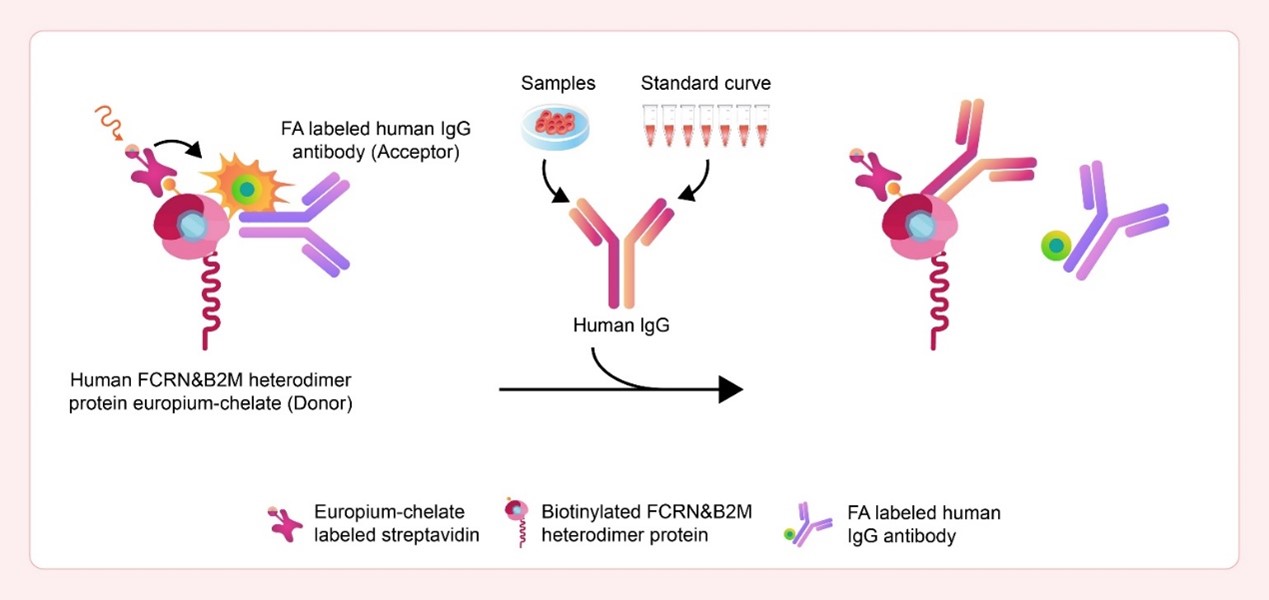
The Human FcRn binding Kit (TR-FRET) is based on a homogeneous (no wash) competition TR-FRET technology (Time-Resolved Fluorescence Resonance Energy Transfer) to measure the interaction between human FcRn and antibody drug candidates or FcRn inhibitors. It is designed to facilitate the half-life evaluation of antibody drug candidates, high-throughput screening of FcRn inhibitors within 0.5-1 hours. It can also be used as a universal detection tool to identify the ability of antibody drugs to bind to FcRn.
Please note that the TR-FRET Sample Dilution Buffer and Detection Buffer are formulated for distinct purposes and should not be mixed or interchanged, as improper use may lead to unexpected or inconsistent experimental results. The Sample Dilution Buffer is intended solely for sample dilution, whereas the Detection Buffer is specifically designed for diluting Donor and Acceptor reagents.
For experiments performed under different pH conditions, be sure to select the appropriate TR-FRET Detection Buffer. For example, TR-FRET Detection Buffer, for pH6.0 Reaction System, (Cat. No. DB-06) must be used for pH6.0 reactions, while TR-FRET Detection Buffer, pH7.4 (Cat. No. DB-05) should be used for pH7.4 reactions.
Storage
1. Store the unopened kit at 2-8°C upon receipt.
2. Locate the expiration date on the outer packaging and do not use reagents beyond their expiration date.
3. The opened kit should be stored according to the storage conditions listed in the Components Table. The shelf life of the opened kit is 30 days from the date of opening.
Materials Provided
IDComponentsSizeFRT01-C01Human FCRN&B2M Heterodimer Protein Europium-chelate100 tests/500 testsFRT01-C02FA Labeled human IgG antibody100 tests/500 testsFRT01-C03Human IgG standard200 μg/100 tests 1 mg/500 testsDB-04TR-FRET Sample Dilution Buffer, pH7.450 mL/100 tests & 500 testsDB-05TR-FRET Detection Buffer, pH7.450 mL/100 tests & 500 testsDB-06TR-FRET Detection Buffer, for pH6.0 reaction system50 mL/100 tests & 500 testsAssay Principles
This Human FcRn binding Kit (TR-FRET) is based on TR-FRET technology (Time-Resolved Fluorescence Resonance Energy Transfer). Use the mixture of biotinylated FcRn and Europium-chelate labeled streptavidin as the donor, FA labeled Human IgG1 antibody as the acceptor.
- In the absence of FcRn-binding components, the donor and acceptor are in close proximity due to the binding of FcRn and FA-labeled Human IgG1 antibody. The donor emits a 620 nm signal upon excitation, which is absorbed by the acceptor, resulting in a 665 nm emission.
- In the presence of FcRn-binding components, they interfere with the donor-acceptor interaction, preventing FRET from occurring.
ACRO Quality Management System
Customers Also Viewed
Performance Data
Bioactivity-TR-FRET
Please refer to DS document for the assay protocol.
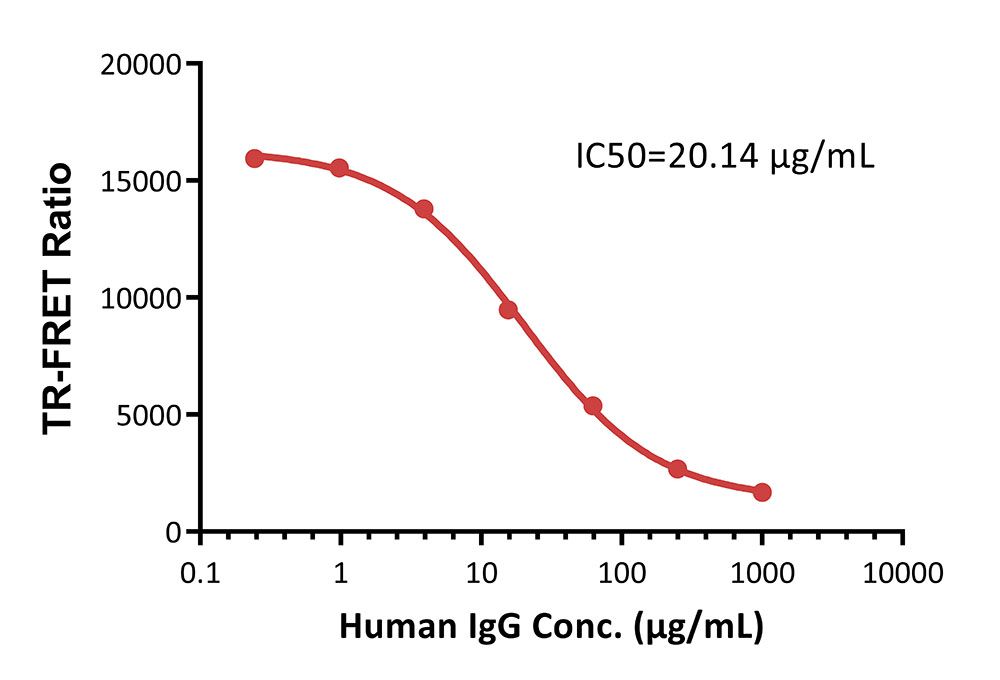
Inhibition of Europium-chelate labeled FcRn: FA labeled human IgG antibody binding by Human IgG (pH6.0)
In this TR-FRET assay, Human FCRN&B2M Heterodimer Protein Europium-chelate is used as the Donor and FA labeled human IgG antibody is used as the Acceptor. An inhibition Assay was performed to evaluate the interaction between Human FCRN&B2M Heterodimer Protein Europium-chelate and FA labeled human IgG antibody using Human IgG standard resulting in a typical IC50 of 20.37 μg/mL (QC tested).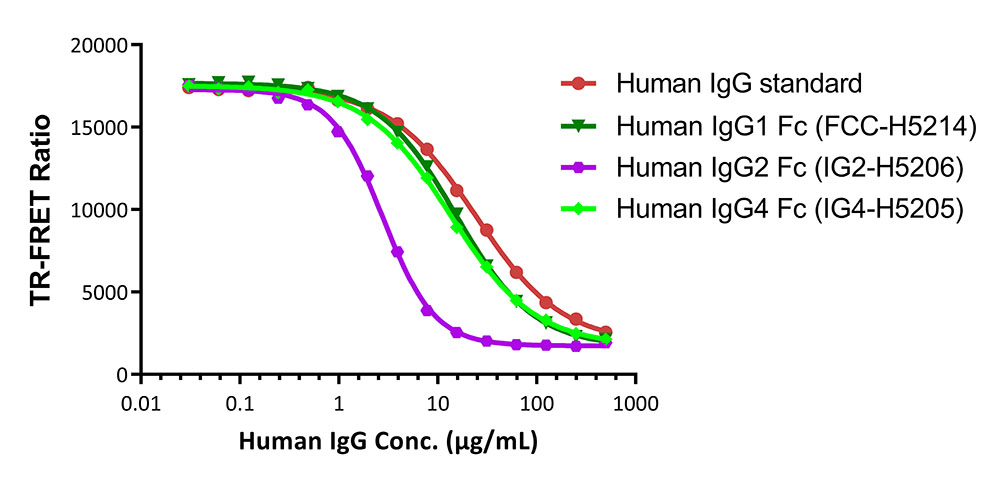
The kit can be used to detect different subclasses of Human IgG Fc proteins (IgG1, IgG2, and IgG4) in a pH6.0 reaction system. These subclasses show different IC50 values.
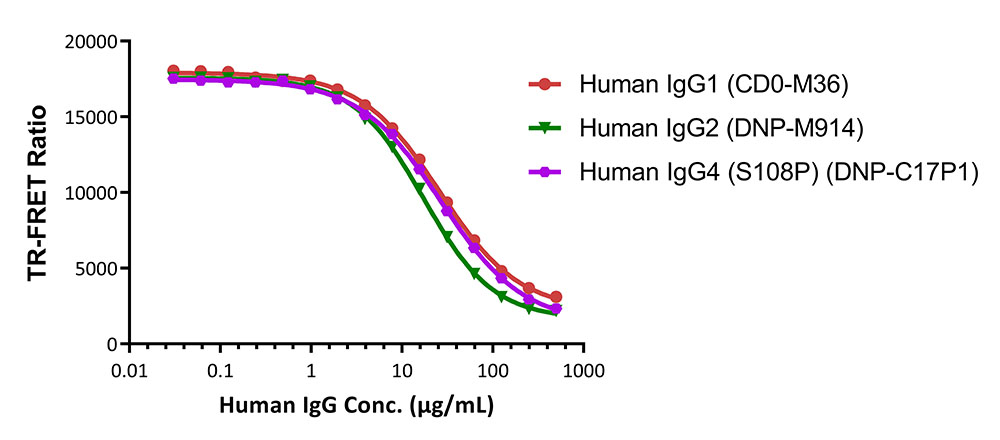
The kit can be used to detect different subclasses of Human IgG (Human IgG1, Human IgG2, and Human IgG4) in a pH6.0 reaction system.
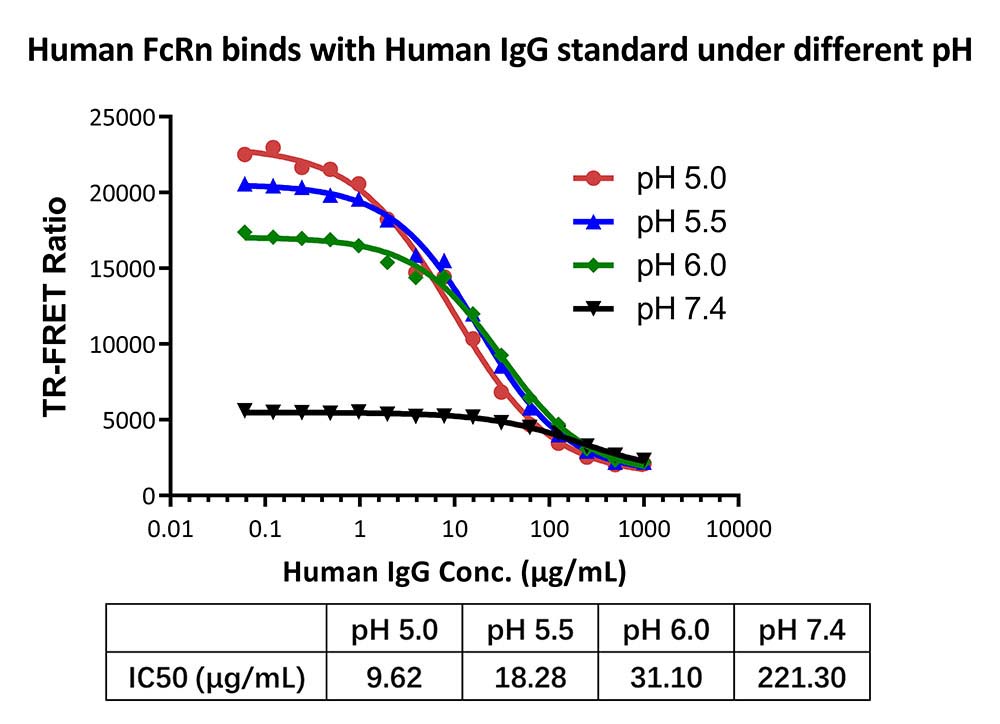
The kit has been used to detect the binding activity between Human FcRn and Human IgG standard under different pH. The IC50 shows a significant increase with increasing pH, which correlates with a decreased binding between Human FcRn and Human IgG standard.
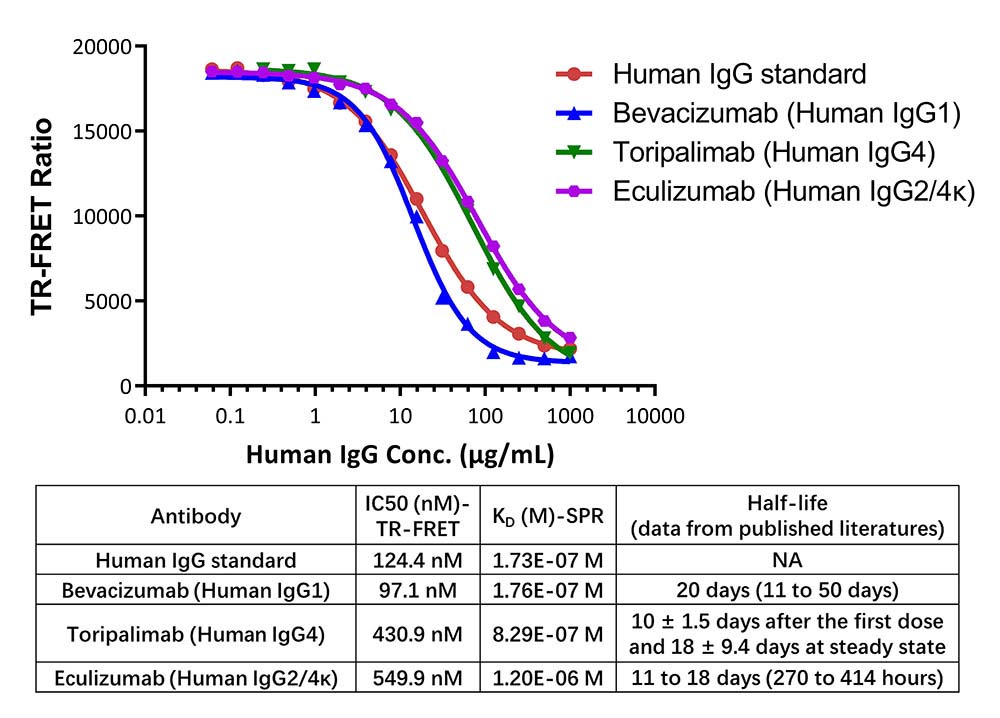
The half-lives of these 3 monoclonal antibodies currently in clinical use generally correlate with the binding affinity to FcRn. The kit has been used to detect 3 FDA approved antibody drugs of different binding affinity to FcRn, and the IC50 trends are consistent with affinity constant from SPR as well as the actual in vivo half-life published.
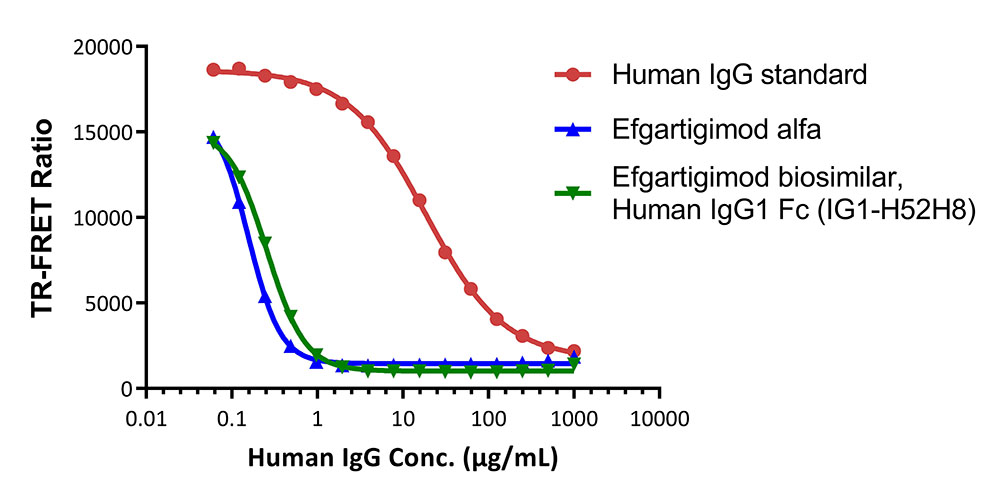
The kit is suitable for detecting FcRn inhibitors. In this TR-FRET competition assay, both Efgartigimod and its biosimilar, Human IgG1 Fc (C103S, M135Y, S137T, T139E, H316K, N317F), His Tag (Cat. No. IG1-H52H8) exhibit strong inhibitory activity.
Customer Reviews Writing Reviews

Recent Advances
 Drug Development Progress
- English Name:
IgG receptor FcRn large subunit p51
- Category:
- Approved Drugs:
4 Details
- Drugs in Clinical Trials:
5 Details
- Highest Development Stage:
Approved
 Contact Us


 Drug Candidate Licensing


