















FcRn(Neonatal Fc Receptor)
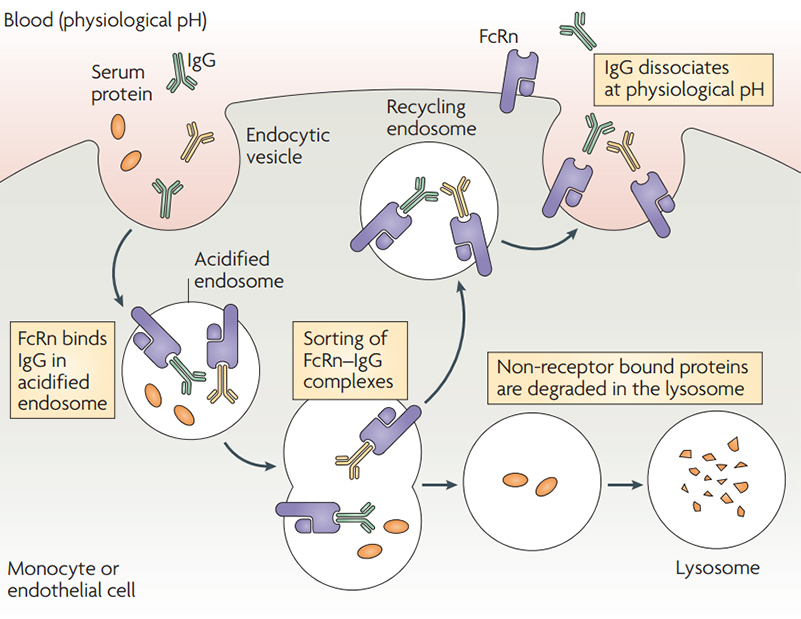
FcRn-mediated IgG and serum albumin recycling
FcRn-mediated IgG and serum albumin recycling

Human FcRn interaction with ligands IgG and albumin
Human FcRn interaction with ligands IgG and albumin
Core Research Applications of FcRn
Why Choose ACROBiosystems' FcRn Products?
Products & Advantages

Half-life optimization
Albumin studies
Cross-species validation
SPR/BLI-validated high affinity
Low endotoxin option (<10 EU/mg)
Heterodimer format expressed in HEK293 cells for proper folding and PTMs
Multi-species & tag options, including Human, Mouse, Cynomolgus and Rhesus macaque

Fc binding comparison
Early half-life assessment
Comprehensive Validation: Tested across antibody subtypes and drugs
High batch-to-batch consistency
Accurate detection aligning with SPR binding trends

Early half-life assessment
FcRn functional validation
Commercially licensed for global research use
Application data supporting assay development and validation
Suitable for IND-enabling studies
 Order
OrderTechnical Validation Data
Heterodimeric FcRn proteins verified by SEC-MALS

The purity of Canine FCGRT&B2M Heterodimer Protein, His Tag&Tag Free (Cat. No. FCM-C52W8) is more than 90% and the molecular weight of this protein is around 43-60 kDa verified by SEC-MALS.
Human FcRn–Herceptin binding affinity (SPR validated)

Immobilized Biotinylated Human FCGRT&B2M Heterodimer Protein, His,Avitag (Cat. No. FCM-H82W7) on SA Chip can bind Herceptin® with an affinity constant of 0.267 μM as determined in a SPR assay (Biacore 8K) (QC tested).
Request ProtocolMouse FcRn–Herceptin binding affinity (SPR validated)

Mouse FCGRT&B2M Heterodimer Protein, His Tag (Cat. No. FCM-M52W8) captured on NTA-Series S sensor chip can bind Herceptin with an affinity constant of 2.52 nM as determined in a SPR assay (Biacore T200) (Routinely tested).
Request ProtocolFcRn–Herceptin binding affinity (BLI validated)

Loaded Cynomolgus / Rhesus macaque FCGRT&B2M Heterodimer Protein, His Tag&Strep II Tag (Cat. No. FCM-C5284 ) on SA Biosensor via Biotin his antibody, can bind Herceptin with an affinity constant of 0.13 μM as determined in BLI assay (ForteBio Octet Red96e) (Routinely tested).
Request ProtocolFCGRT&B2M–Serum Albumin binding affinity (BLI validated)

Loaded Biotinylated Human FCGRT&B2M Heterodimer Protein, His,Avitag (Cat. No. FCM-H82W7) on SA Biosensor, can bind Human Serum Albumin, His Tag (Cat. No. HSA-H5220) with an affinity constant of 0.647 μM as determined in BLI assay (ForteBio Octet Red96e) (Routinely tested).
Request ProtocolFcRn TR-FRET Binding Kit Performance Validation

The half-lives of these 3 monoclonal antibodies currently in clinical use generally correlate with the binding affinity to FcRn. The kit (Cat.No.FRT-01) has been used to detect 3 FDA approved antibody drugs of different binding affinity to FcRn, and the IC50 trends are consistent with affinity constant from SPR as well as the actual in vivo half-life published.
Request Protocol
The kit (Cat.No.FRT-01) is suitable for the detection of FcRn inhibitors. It shows that both Efgartigimod and its biosimilar, Human IgG1 Fc (C103S, M135Y, S137T, T139E, H316K, N317F) His Tag (Cat. No. IG1-H52H8) exhibit good inhibitory activity in this TR-FRET competition assay.
Request ProtocolFunctional Validation of FcRn Stable Cell Lines

FACS assay shows that FITC-Labeled Human IgG1 Fc (C103S, M135Y, S137T, T139E, H316K, N317F) Protein, His Tag (Cat. No. IG1-HF2H3) can bind to HEK293/Human FcRn (FCGRT & B2M) Stable Cell Line. HEK293/Human FcRn (FCGRT & B2M) Stable Cell Line (Cat. No. CHEK-ATP079) was red line, negative control HEK293 cells was grey line(QC tested).
Request ProtocolResources & Documentation
Resources


Related Reading

References
-
1. The mechanism of intestinal uptake and transcellular transport of IgG in the neonatal rat. The Journal of Clinical Inveatigation. 1972, 51:2916–27. Authors:Jones EA, Waldmann TA.
-
2. FcRn: the neonatal Fc receptor comes of age. Nature Reviews Immunology. 2007,7:715–725. Authors:Derry C. Roopenian, Shreeram Akilesh.
-
3. Howard. FcRn expression in cancer: Mechanistic basis and therapeutic opportunities. Journal of Controlled Release. 2021, 337 :248–257. Authors:Imke Rudnik-Jansen, Kenneth A.
-
4. Antagonism of the Neonatal Fc Receptor as an Emerging Treatment for Myasthenia Gravis. Frontiers in Immunology. 2020, 10. Authors:Karissa L. Gable, Jeffrey T. Guptill.
- Background
- Products & Advantages
- Product List
- Technical Validation Data
- Resources & Documentation
- Featured Recommendations
- References


Online Message
[North America]: 1 Innovation Way, Newark, DE 19711, USA [Switzerland]: Switzerland Innovation Park Basel Area, Novartis Campus, Lichtstrasse 35, 4056 Basel
Email:order@acrobiosystems.com
Copyright © 2025 ACROBiosystems. All Rights Reserved
BettinastraBe 30, 60325 Frankfurt am Main